Reduce employee shuttle
dispatch costs by up to 40%
Visualize ridership with QR scans and automatically generate
minimum-cost dispatch plans using mathematical optimization
About
What is MiiHawk?
MiiHawk is a shuttle bus dispatch optimization cloud for factories and manufacturers in Southeast Asia. QR/NFC scans measure who actually boards, and that measured data drives the automatic calculation of the lowest-cost mix of vehicle types and counts. Unlike GPS route optimization, which shortens driving distance, MiiHawk cuts the vehicle cost itself — reducing dispatch costs by up to 40%.
- Delivery
- Cloud (web + smartphone; no dedicated hardware required)
- Price
- 150 THB per employee per month (all features, annual contract)
- Free trial
- 14 days, all features, no headcount limit, no credit card
- Regions
- Thailand, Myanmar, Vietnam, Indonesia, Malaysia
- Languages
- Japanese, English, Thai
- Provider
- TechJapan LLC. (implementation support in Thailand: Siam System Consulting Co., Ltd. / sales contact: ECMS LTD.)
In many Southeast Asian industrial estates, public transport is scarce — the company shuttle is effectively the only way employees can get to work. That makes shuttle spend an unavoidable fixed cost that keeps growing. The flip side: the room to optimize it is just as large.
Employee shuttle costs are higher than you think
3,600+
Monthly trips (20 routes, 3 shifts)
3.6M THB
Monthly shuttle cost
43M THB
Annual shuttle cost
* Based on 1,000 THB/trip, 20 routes, 3 shifts (30 days)
Problems
Do you face these challenges?
High costs
Employee shuttle fixed costs keep growing, but you don't know how to reduce them.
Low occupancy
Buses running with only 4-5 passengers. The actual situation is invisible.
No ridership data
Unknown who boards where. Collecting ridership data is labor-intensive.
Manual planning
Dispatch planning depends on individual expertise. Hard to handle overtime and sudden changes.
Billing Verification
Can you verify that invoice against reality?
Is the bill from your bus company or driver actually justified? On most sites, you have no choice but to trust the invoice. MiiHawk gives you boarding-level evidence to put the proof back into billing.
01
Recorded trip by trip
QR/NFC scans capture which trip each person boarded and when — real counts from the field, not numbers on a ledger.
02
Plan vs. actual, side by side
The daily report shows the billed assumptions (planned vehicles and seats) next to actual ridership and occupancy.
03
Question and negotiate with evidence
Pinpoint near-empty trips and trips you cannot confirm ever ran, and explain every charge to management with numbers.
* Objective scan data and daily reports give you a defensible basis to verify billing.
Why MiiHawk
4 Unique Advantages
MiiHawk is not just another GPS route optimizer
01
Start instantly with just smartphones
No dedicated hardware or RFID equipment needed. Use existing smartphones as QR/NFC readers — zero initial investment required.
02
Proprietary mathematical optimization engine
Instead of GPS route optimization, we focus on optimizing vehicle type and quantity combinations. Mathematically derive the lowest-cost way to transport the same passengers.
03
Data builds up as you use it
No master data registration or preparation needed. Scanning automatically creates provisional records — a progressive design where data accumulates through daily operations.
04
Every dispatch backed by evidence
Instead of individual judgment, algorithms calculate the cost-minimum rationale. Ensures management accountability and eliminates room for fraudulent billing or inflated operations.
Features
9 Benefits of MiiHawk
Reduce costs by optimizing fleet size & types
Automatically calculate route consolidation, vehicle downsizing, and trip reduction using mathematical algorithms — directly cutting costs.
Dramatically reduce dispatcher workload
Create dispatch plans in a few clicks. Calculations complete in under 1 second, enabling instant re-planning for shift changes.
Dual QR + NFC scanning
Scan QR codes with camera or tap NFC cards. Both methods run simultaneously — choose whichever fits your on-site operations.
Works offline without interruption
The in-vehicle terminal works as a dedicated app that stores data safely on the device. Scanning continues in areas with no signal, and auto-syncs once the connection is restored.
Start immediately, no master data needed
Scanning an unregistered card automatically creates a provisional record. Start operations without preparing employee lists — data builds up as you go.
Visualize routes & vehicles with Google Maps
Place bus stops and edit routes directly on the map. View stops, distances, and ridership for each route at a glance.
Automated cost reduction suggestions
Auto-generates 3 types of rule-based suggestions: vehicle downsizing, fleet-size reduction, and quote requests for cheaper unregistered vehicle tiers. Prioritized by savings amount.
6 built-in reports for better decisions
Daily dispatch actuals, route cost analysis, vehicle analysis, monthly summary, vehicle type efficiency, and CO2 emissions — all with Excel export.
Auto-generated bus departure timetable
Reverse-calculate departure times for each stop from shift schedules and stop order. GPS data and traffic pattern learning improve accuracy by day and time.
Product
Product Screenshots
Cloud admin console — works on PC, tablet & smartphone
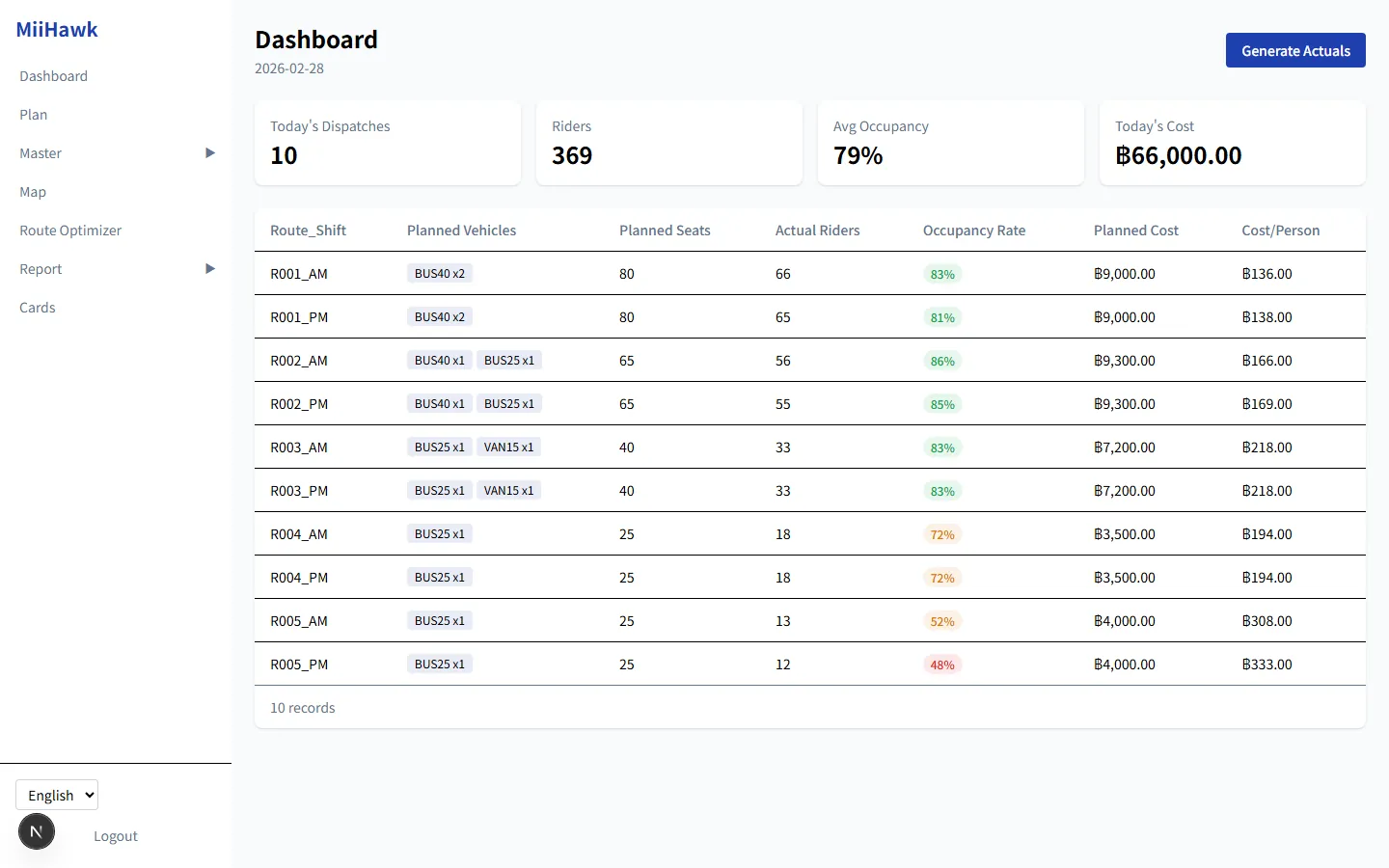
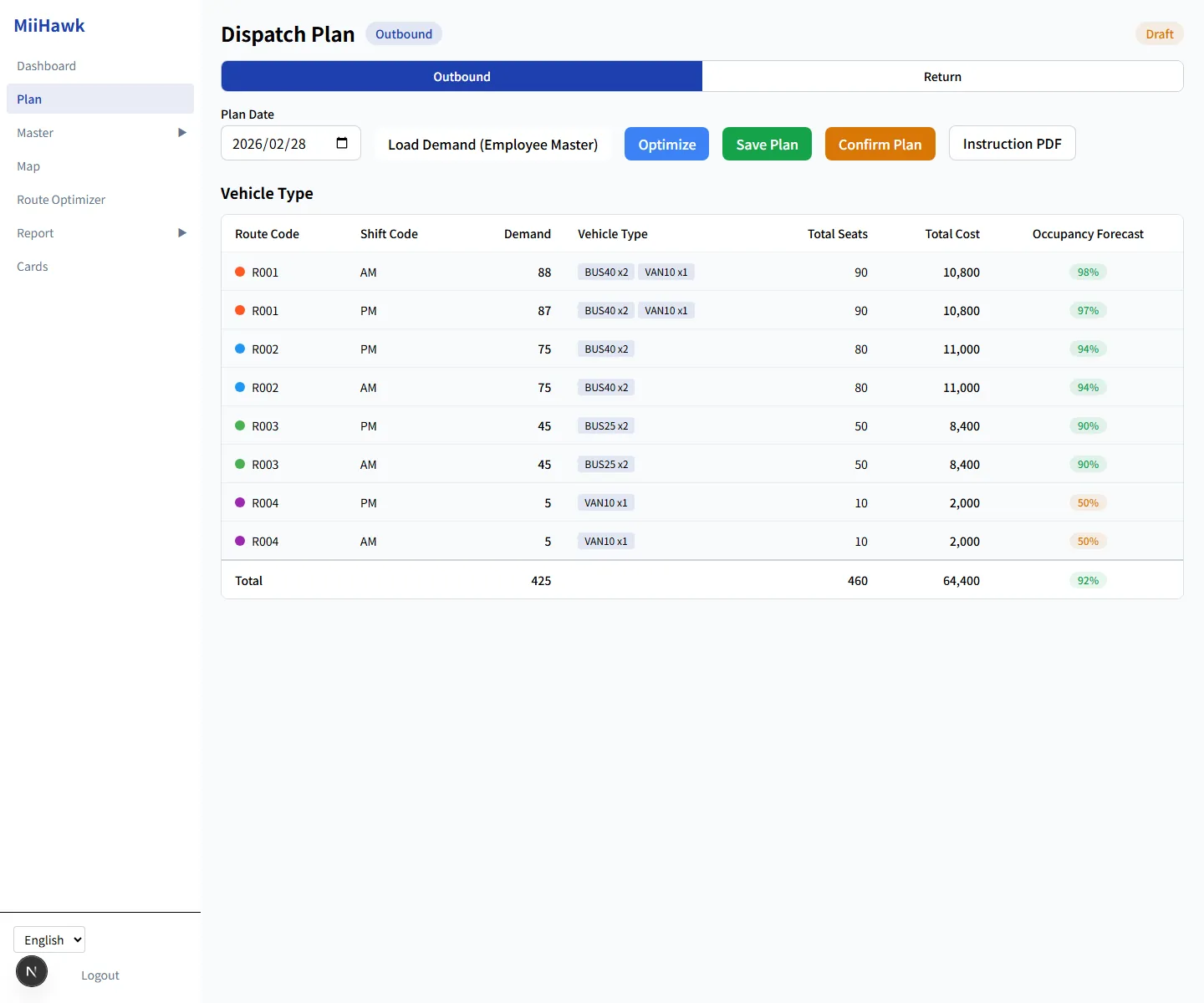
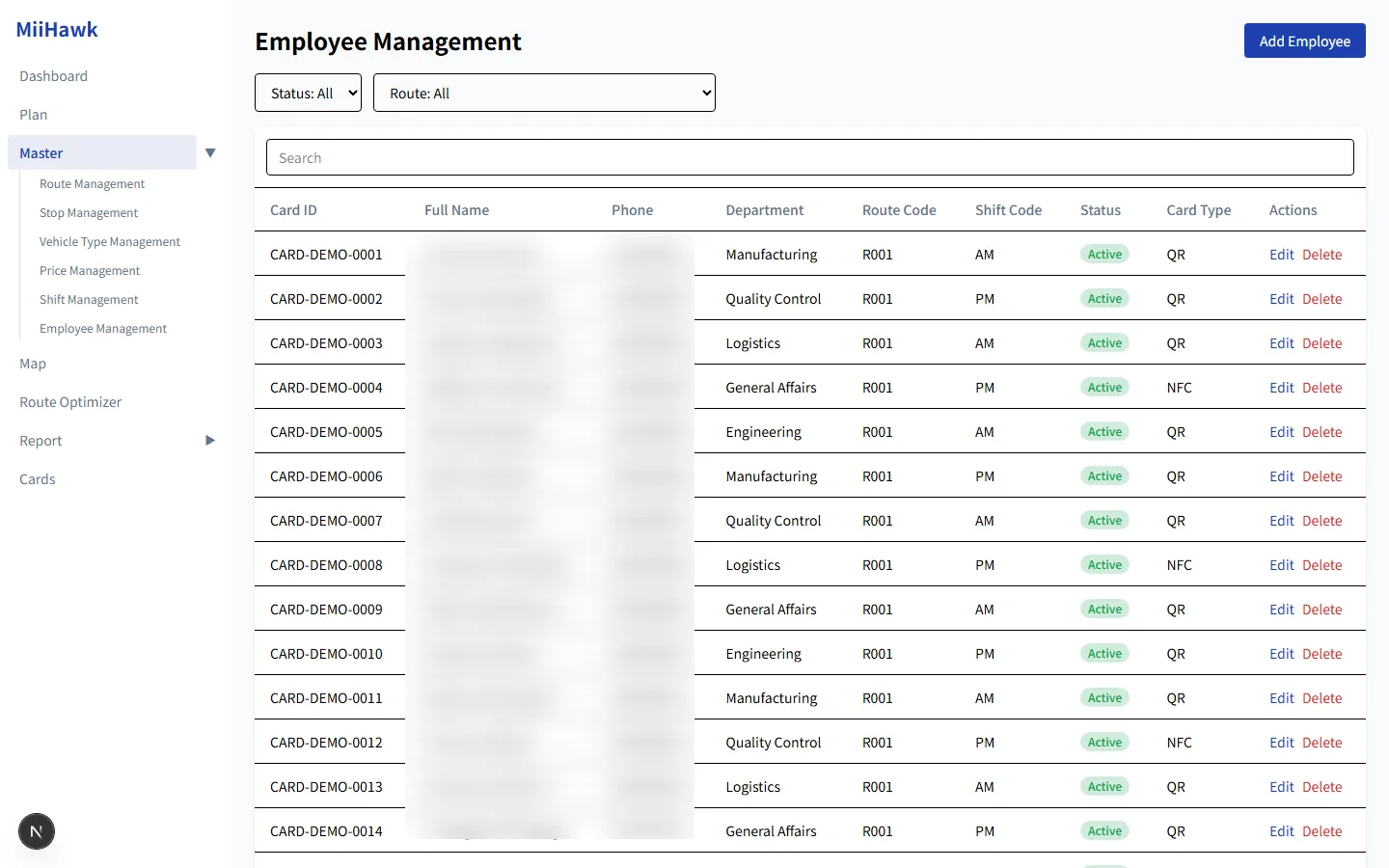
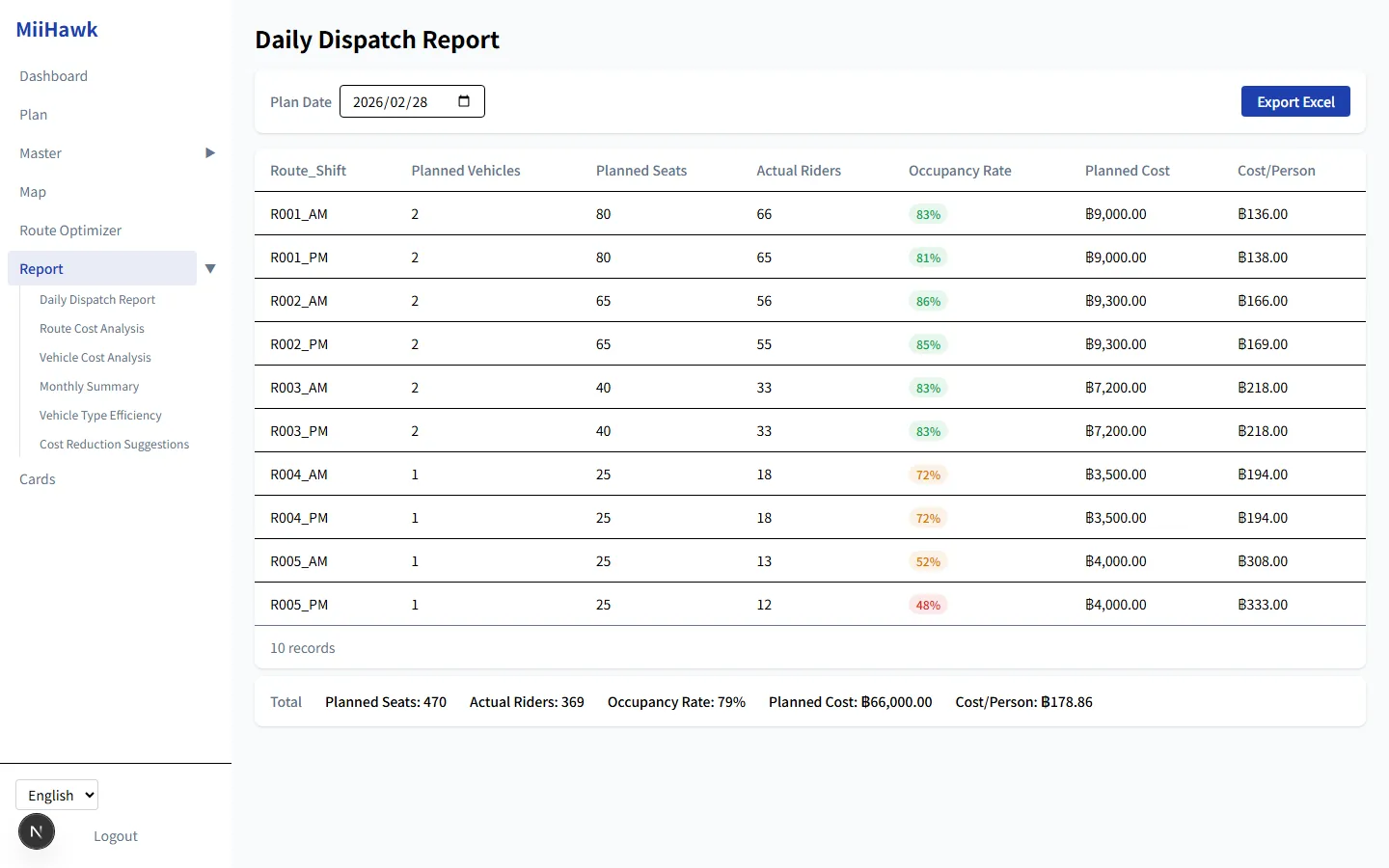
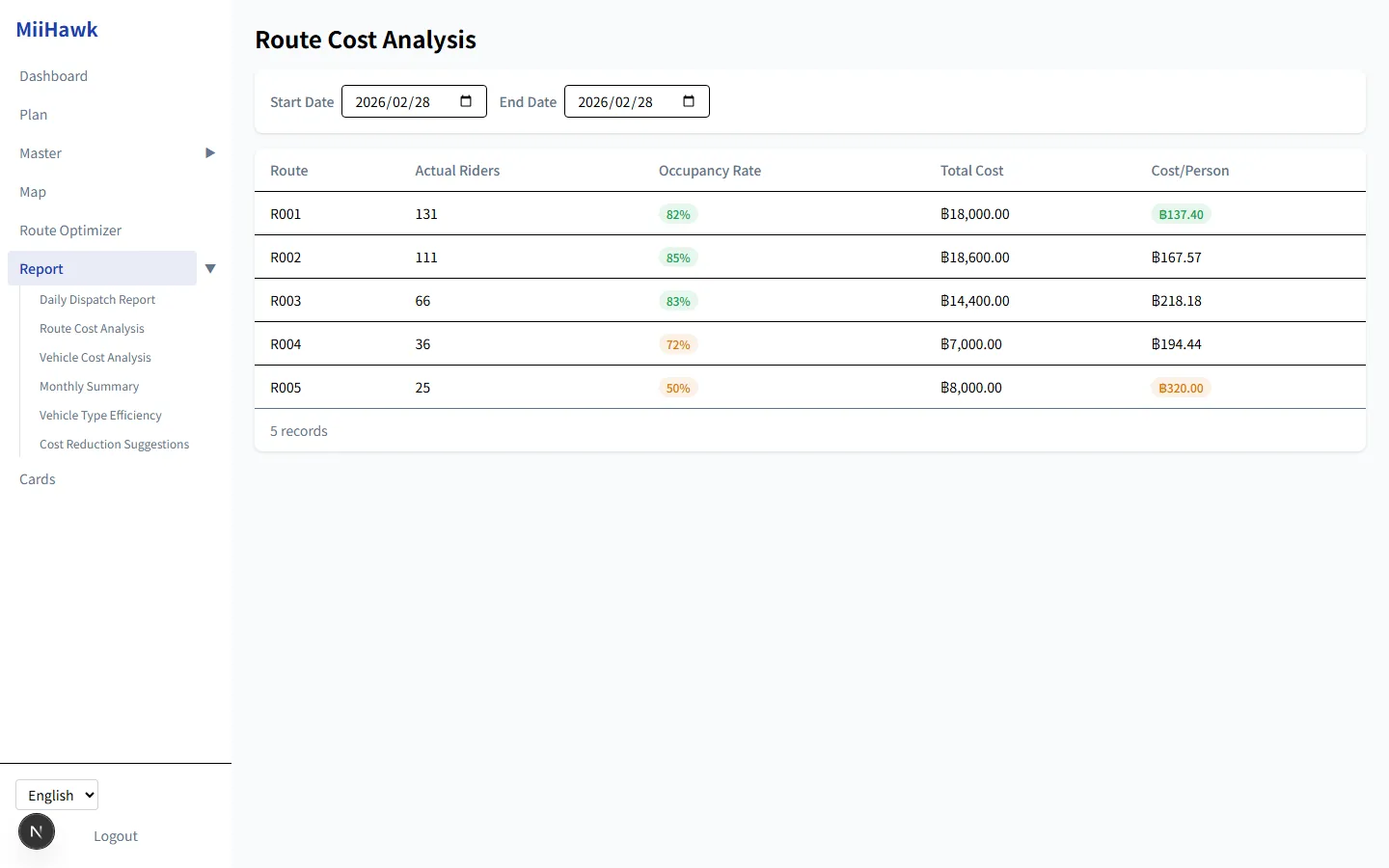
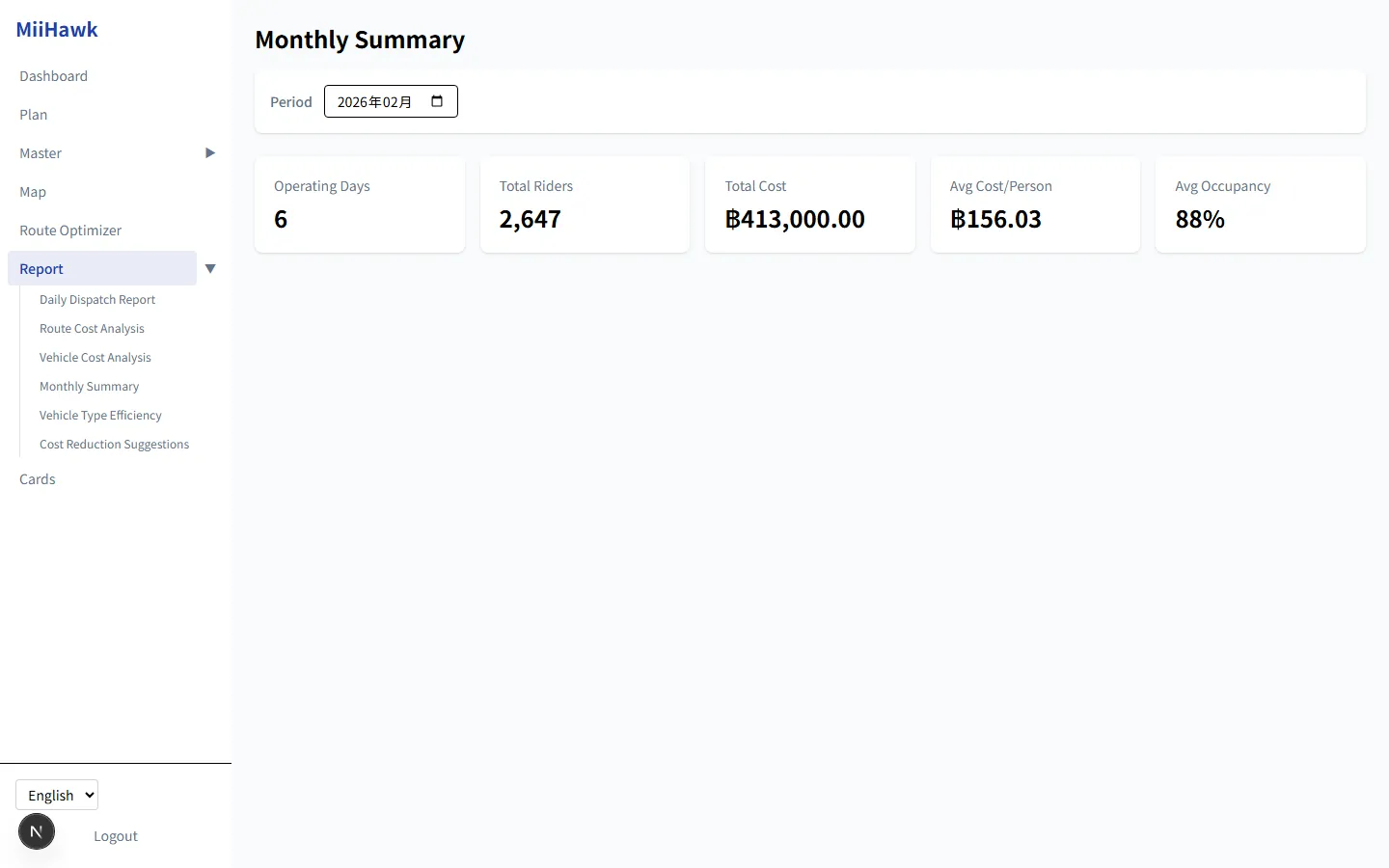
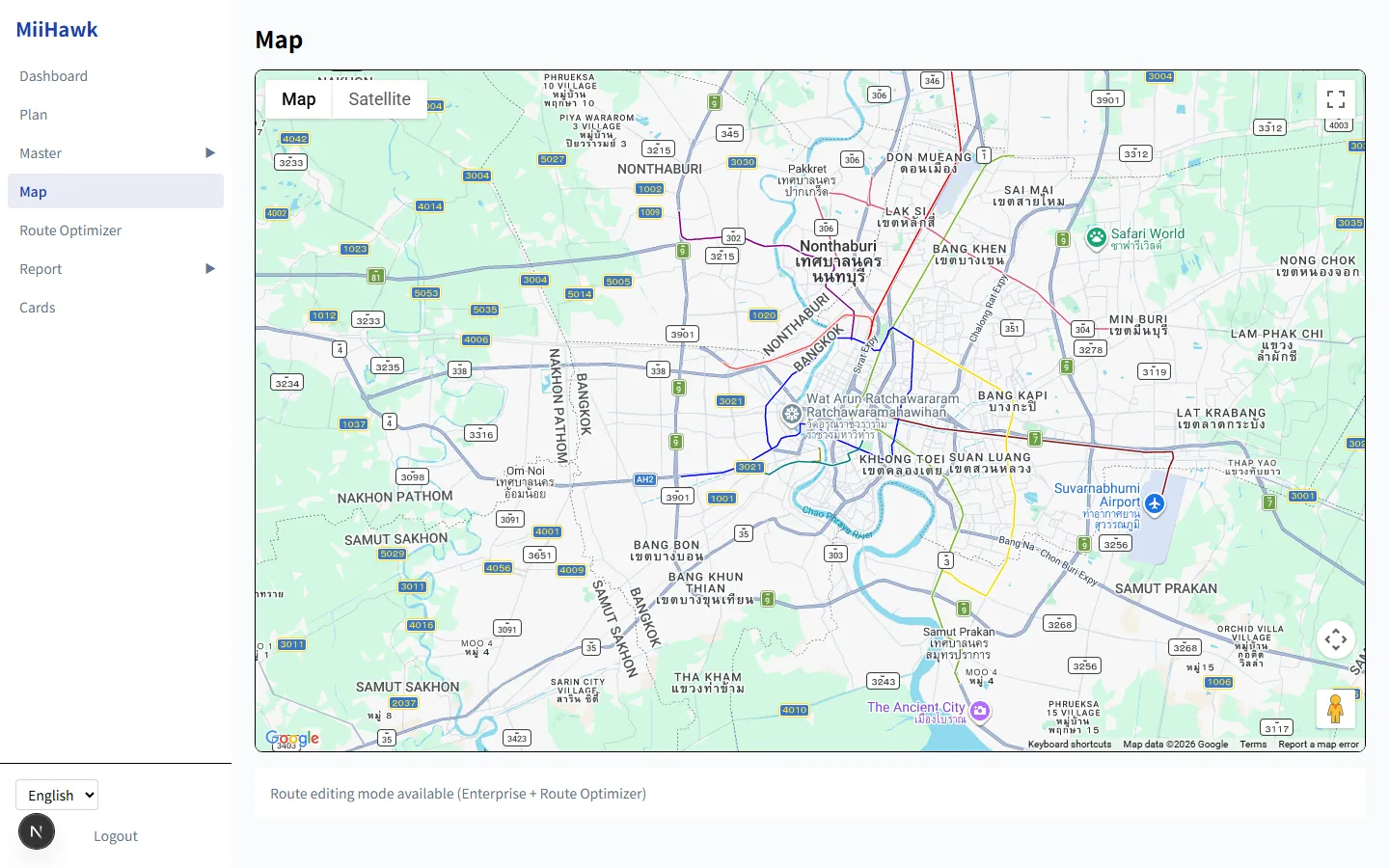
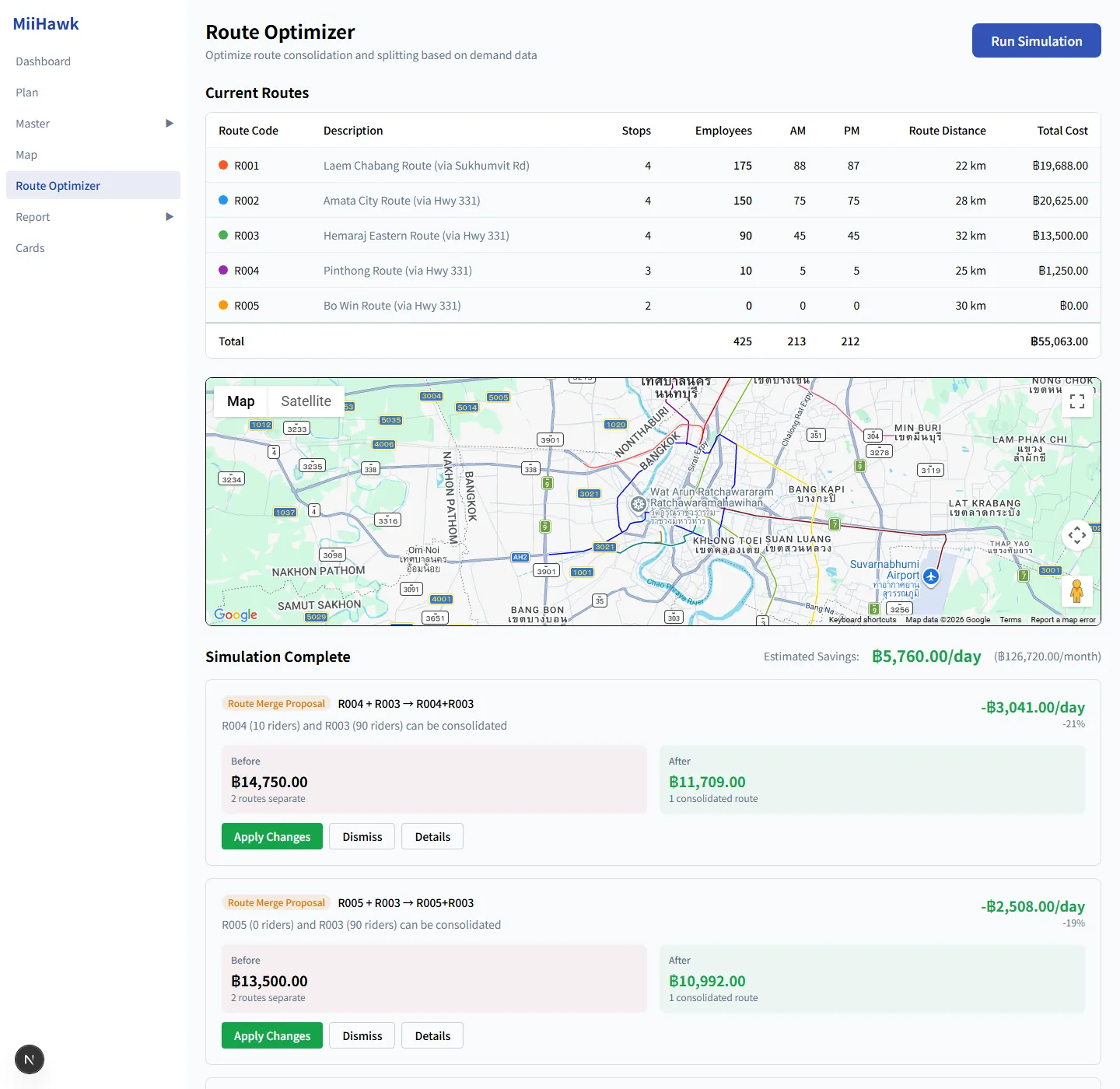
* Click any image to enlarge
Technology
Continuous cost optimization with the TALON cycle
Run 4 phases daily to continuously improve dispatch costs
Track
Collect ridership data daily via QR/NFC scans
Analyze
Compare plan vs actuals with 6 report types
Plan
Proprietary engine auto-generates optimal next-day dispatch
Rebuild
Quarterly route restructuring for further savings
AI Advisor INCLUDED
- Recommends whether to optimize dispatch first or restructure routes, with supporting evidence
- Summarizes report data in natural language for direct use in management reporting
- Compares multiple cost reduction scenarios: "Combining A+B saves XX THB/month"
- Reads day-of-week and seasonal patterns in your data and surfaces hints for reviewing plans
- Answers free-form questions like "Why did R02 costs increase last month?"
How It Works
3 Steps to Cost Reduction
Phase 1 — Track
Understand Current State
Install QR/NFC reader terminals on vehicles. Employees scan their ID cards to board. Collect "when, who, from where" ridership data in real-time.
Install Reader Terminals
Set up QR/NFC reader terminals (mobile devices) on each vehicle
Scan Employee ID
Employees simply tap their RFID-enabled ID card to record boarding
Auto Data Collection
Real-time automatic aggregation of scan data, with CSV/Excel export
Phase 2 — Plan
Create Dispatch Plans
Combine collected ridership data with shift plans. Mathematical algorithms automatically calculate minimum-cost vehicle types and quantities.
Import Shift Schedule
Simply upload your Excel shift schedule to import
Run Optimization Engine
Proprietary optimization engine calculates minimum-cost vehicle mix in under 1 second
Export Dispatch Plan
Download optimized results as Excel to share with bus companies
Goal
Achieve Cost Reduction
Operate buses according to optimized dispatch plans. Reinvest saved costs into capital equipment and employee benefits.
Consolidate Routes
Merge low-occupancy trips to eliminate empty bus costs
Downsize Vehicles
Switch from large buses to vans, significantly reducing per-vehicle cost
Verify with Dashboard
Visualize cost trends and occupancy in real-time for continuous improvement
Case Studies
Case Studies
Case A
Metal Processing Manufacturer
2,000 employees / 50 routes
Monthly Trips
5,990 trips 3,707 trips39% reduction
Occupancy Rate
32% 59%Nearly doubled
Monthly Cost Savings
1.5M THB/month saved
40% reduction
"We were able to implement data-driven improvements step by step, also contributing to CO2 reduction." — General Affairs Director
Case B
Auto Parts Manufacturer
Person-dependent dispatch planning was the issue
Before
Daily dispatch planning depended on individual staff. Reports took 1-2 months even after improvement proposals.
After
Improvement points became immediately visible. Reduced dispatcher workload, enabling resource reallocation to other tasks.
"We can now see at a glance where there's room for improvement." — HR & Admin Manager
Case C
Electronics Manufacturer
Realized how high shuttle costs were
35%
Cost reduction achieved
"We were surprised there was 35% room for reduction." — CEO
Plans
One Price, All Features
Pricing Update
Switched to One Price in April 2026
We retired the three-tier edition structure (Limited / Enterprise / Enterprise + Route Optimizer) in favor of a single price that includes every feature. Existing customers receive the full feature set at no additional cost.
MiiHawk One
All features, all routes, all employees
150 THB
/ employee / month
- QR/NFC scan & real-time ridership monitoring
- Dashboard, 6 report types & offline support
- Mathematical optimization & automated dispatch planning
- Route consolidation algorithm & Google Maps integration
- AI Advisor (no extra cost), Excel / PDF export
- 14-day free trial (no size limit), annual contract
* Custom pricing available for 5,000+ employees
Value Added by One-Price Model
No feature gates
Route Optimizer and AI Advisor are now available from day one — even to the smallest deployments.
No phased rollout lock-in
Phase 1 (track) → Phase 2 (plan) → Phase 3 (route optimization) — adopt at your own pace.
Simple budgeting
Just employees × 150 THB. No edition upgrades, no re-contracting — easy for the CFO to approve.
Target
Ideal for these companies
300+
300+ employees
Factories in industrial zones
with limited transportation
Rotating shift schedules
and complex work patterns
Companies seeking
fixed cost reduction
Effectiveness
Why Cost Reduction Works
Not just theory.
An optimization algorithm proven by real-world experiments.
Our vehicle type and fleet size optimization has been repeatedly validated with real operational data.
How Optimization Works
Shuttle fleets include different vehicle types — large buses, medium buses, and vans — each with different capacities and costs. Yet most companies run the same vehicle mix every day, regardless of actual ridership. MiiHawk analyzes daily ridership data to automatically calculate the optimal combination of vehicle types and quantities for each day's demand. By reducing empty seats on large buses and strategically deploying smaller vehicles, you transport the same number of people at significantly lower cost.
2+ Types
More vehicle types mean more cost-saving combinations
Daily Change
Fluctuating demand makes daily re-optimization valuable
3+ Routes
More routes create greater opportunities for consolidation
Consider MiiHawk if you face these situations
Cannot justify shuttle costs
You don't know if payments to the bus company are reasonable. When management asks "why this many buses?", you can't explain the basis. Start by making the current situation visible with data.
Headcount and shifts change frequently
When daily ridership varies due to hiring, overtime, holidays, or seasonal changes, a fixed dispatch pattern creates waste. Recalculating based on daily actuals delivers real savings.
Multiple vehicle types available but underutilized
Large buses, medium buses, and vans are all available from your provider, but you always dispatch the same type. Simply changing the vehicle mix can create significant cost differences.
Dispatch planning depends on one person
With many routes and shifts, manual planning has hit its limit. If the person in charge leaves, nobody can create the dispatch plan. This is a business continuity risk.
When Cost Reduction is Limited
In the following cases, cost reduction through dispatch optimization will be limited. Please confirm before proceeding.
- Only one vehicle type is available (e.g., large buses only) — Without multiple vehicle sizes to combine, you simply count how many vehicles are needed.
- Ridership per route/shift is always the same — If the same number rides every day, the dispatch pattern never needs to change.
- Ridership per route/shift fits in a single vehicle — Just dispatch the cheapest vehicle that covers the demand. No combination optimization needed.
* Even in these cases, MiiHawk remains effective for visualizing ridership data and providing evidence for negotiations with bus companies.
Pricing
Simple Pricing
One price per employee
150 THB
/ employee / month (all features)
AI Advisor uses your Google AI Studio account (no extra cost)
- No initial setup cost (use smartphones)
- No dedicated hardware or RFID equipment needed
- Easy deployment & operation as a cloud service
* Contact us for a detailed quotation
Industry Price Comparison
Monthly cost per employee (Thailand, public-source benchmarks)
Source: Capterra & Locus.sh public pricing reports (as of May 2026)
Comparison
Why Choose MiiHawk
| MiiHawk | Competitors | |
|---|---|---|
| Approach | Occupancy rate optimization | Route optimization |
| Initial cost | Low (smartphone-based) | High (RFID equipment required) |
| Monthly fee | 150 THB/person/month (One Price) | Not disclosed (quote-based) |
| Cost reduction | High (optimize trips & vehicle types) | Limited |
After MiiHawk
How operations and management change after MiiHawk
Before
- ✕ No choice but to trust the invoice
- ✕ Dispatch hinges on individual experience — a black box
- ✕ Ridership is invisible; you cannot justify costs
After (MiiHawk)
- ✓ Verify billing against trip-by-trip actuals
- ✓ Anyone builds the minimum-cost plan in a few clicks
- ✓ Occupancy and gaps at a glance — every cost backed by numbers
Costs keep falling, and decisions shift from gut feel to data.
14-Day Free Trial
Try every feature on every route for every employee — no size limits during trial. Please contact us separately for onboarding training costs.
✓ No credit card required / ✓ No auto-billing after trial / ✓ Cancel anytime
14 Days
Free trial period
All routes
Target routes
No size limit
Max employees
FAQ
Frequently Asked Questions
What equipment do we need to get started?
None. No dedicated hardware or RFID equipment is required — your existing smartphones work as QR/NFC readers, so you can start with zero upfront investment.
How much cost reduction can we expect?
Case studies have achieved up to 40% savings. By consolidating low-occupancy trips, downsizing vehicle types, and optimizing fleet size, you move the same passengers at lower cost. Results depend on how many vehicle types you have, how much demand fluctuates, and how many routes you run.
Can we verify whether an invoice from a bus company or driver is correct?
Yes. QR/NFC scans record who boarded which trip and when, so you can reconcile billed operations against what actually ran — trip by trip. Ghost trips and over-dispatching become visible, and you can justify every charge with evidence.
Can we trace why actual results differ from the plan?
The daily dispatch report reconciles planned vehicles and seats against actual ridership, per route and shift, and visualizes the gap and occupancy rate. You can explain after the fact why a particular trip cost more than expected.
What kind of companies and regions is it best for?
Best for companies in industrial estates where public transport is scarce and the shuttle is effectively the only way to commute. The more you run 300+ employees, rotating shifts, and multiple routes, the larger the optimization gains.
Does it work offline or at sites with poor signal?
Yes. The in-vehicle terminal keeps scanning even in factory zones or basements with no signal, and syncs automatically once the connection is restored.
How long does implementation take?
You can start the same day. No employee master registration is needed upfront — scanning auto-creates provisional records, and your data fills in as you operate.
What about security, languages, and the free trial?
Traffic is always encrypted, and we comply with PDPA, GDPR, and the Japanese personal-data protection law. Japanese, English, and Thai are supported. The 14-day free trial includes all features with no headcount limit and needs no credit card.
What is MiiHawk?
MiiHawk is a cloud service for optimizing employee shuttle dispatch for Southeast Asian manufacturing. It collects boarding data via NFC/QR scanning and automatically calculates the minimum-cost vehicle combination. It can reduce dispatch costs by up to 40%.
How is this different from GPS route optimization?
GPS route optimization reduces travel distance, while MiiHawk optimizes vehicle type and count combinations to minimize costs. Even on the same route, it reduces vehicle costs themselves — for example, replacing one large bus with two minibuses based on passenger count.
How can shuttle bus costs be reduced?
MiiHawk optimizes vehicle type and count combinations based on actual boarding data to identify excess vehicles and low-occupancy routes. Through right-sizing, route consolidation, and daily response to demand fluctuations, dispatch costs can be reduced by up to 40%.
Can dispatch planning be automated?
Yes. MiiHawk’s optimization engine automatically calculates the minimum-cost vehicle allocation from boarding data. Since demand fluctuates daily, it automatically recalculates every day to maintain the optimal dispatch plan.
Is dedicated hardware needed for NFC/QR boarding management?
No. Existing smartphones serve as readers, so you can start boarding management with zero initial investment. Collected data is automatically fed into dispatch optimization.
What reports can be exported?
Six report types are available, including daily and monthly boarding records, route occupancy rates, and dispatch cost trends — all with Excel export. They support data-driven management decisions.
Contact
Get in Touch
Contact us for free trial, demo requests, quotations, or any questions.
Available Countries
Available in 5 Southeast Asian Countries
Thailand
Thailand
Myanmar
Myanmar
Vietnam
Vietnam
Indonesia
Indonesia
Malaysia
Malaysia
Multilingual support (Japanese, English & Thai)
Our Team
Representative Profile
興野 剛 Go Kyono
CEO, TechJapan LLC.
Former CTO of companies with 500M+ JPY capital and IT consulting for listed enterprises. 15+ years of DX support across 100+ companies in Southeast Asian manufacturing, spanning six domains including IT, financial accounting, HR, and production management. Extensive experience in AI adoption, system development, offshore development, and groupware implementation. Through 300+ on-site interviews at Japanese factories, uncovered widespread fraudulent billing and inflated operations in Southeast Asian employee shuttle dispatching, and developed a mathematical optimization model to eliminate these issues. Productized as MiiHawk.
Developer Profile
斎藤 悠樹 Yuki Saito
Siam System Consulting Co., Ltd. CEO
After starting at an IT company in Fukushima, founded Jibunryu Inc. in 2011 and became COO in 2012. Designed, built, and maintained financial systems for banks, entertainment membership management systems, and postal systems. Seconded to Siam System Consulting Co., Ltd. in 2018, leading proposals, implementation, and support for SuperStream-NX and kintone. Known as a "Plugin Sommelier" for kintone, constantly evaluating tools and plugins to match customer needs. Since 2021, has been designing, developing, and maintaining electronic authentication infrastructure systems. Began promoting mitoco in Thailand in 2023. Motto: "Never cause trouble for others."